In a cycle where ground-up hotel development may still unachievable, conversions can feel like the faster, cheaper alternative…in theory. Their allure is understandable with today’s high development costs and long timelines.
HVS’ 2024 U.S. Hotel Development Cost Survey pegged median total development cost at $423,000 per key for full-service hotels, and $1.1 million per key for luxury. These costs keep some investors focused on the repositioning play, even though it’s not an automatic win.
Will Woodworth, senior vice president of investments at Peachtree Group, believes the conversion play boils down to one (two) thing(s).
“The underwriting approach to conversions has shifted significantly in recent years, driven by one overarching reality: everything is more expensive and takes longer,” he says.
This is both an argument for conversion and an argument against, as the costs and timelines associated with this strategy have also increased.
Reposition or red flag?
To Woodworth, the decision to move forward with a conversion or not is simple.
“A conversion can be pursued when market fundamentals are strong enough to support additional rooms, a compatible building exists in the market to convert and repurposing that building will result in a lower investment basis than ground-up construction,” he says.
In terms of market fundamentals, Adam Lara, principal at KTGY architecture firm in Chicago, prefers downtown urban markets where construction costs are typically at peak levels.

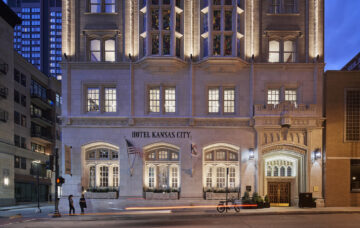
KC Hotel, Kansas City Mo.
“These are prime opportunities for conversions,” he adds.
When it comes to building compatibility, Travis Burns, executive vice president of development for Remington, likes structures with solid bones.
“Smaller-footprint hotels and well‑located legacy buildings often convert more cleanly than oversized or operationally complex properties,” he says. “Starting condition always matters.”
It helps if the existing building offers something you can’t easily replicate with new construction, such as location, ceiling heights, character or entitlement certainty.
“We are seeing success where the asset aligns reasonably well with hotel planning fundamentals: structural grid, bay spacing, floor-to-floor heights and back-of-house capacity,” Lara adds.
Meanwhile, physical constraints may erode a conversion’s lower investment basis.
“Look at functional obsolescence and weigh out where it’s acceptable versus unacceptable,” Woodworth says. “Low ceilings, thin windows and poor utility performance may hamper the guest experience and impact operational efficiencies, and while a conversion capex plan may meet brand and code requirements, inherent building issues may stand in the way of profitability.”
Deferred maintenance is another hurdle.
“Conversion opportunities often exist precisely because a building is no longer serving its original purpose,” Woodworth continues.
Long-vacant office buildings may look viable on paper, but that vacancy period could also exacerbate nascent issues that morph from routine maintenance to significant deferred maintenance issues.
Lara has seen this happen in adaptive reuse projects, especially with MEP systems in older office or residential conversions where vertical distribution, electrical capacity or bathroom stacking don’t jive with hotel use.
“The real challenge is how quickly scope expands once walls are opened and systems are coordinated,” Lara says, noting that code compliance – particularly accessibility, fire/life safety and energy codes – can dramatically reshape layouts and reduce key counts. “From a design standpoint, what often gets overlooked is how much custom problem-solving is required in adaptive reuse, which drives design fees, coordination time and construction complexity.”
In other words: increased costs and timelines.
De-risking the deal before construction
Sizing a building up before one discover what’s behind its walls introduces the one thing investors try to minimize.
“The uncertainty that often comes from working in older buildings,” Woodworth says. “This means that we are not only met with higher costs, but are forced to carry substantially larger contingencies into project budgets to account for unforeseen issues.”
The way to minimize uncertainty, of course, is to remain proactive and carry out extensive due diligence. Upfront.
“Complexity is most often underestimated at the intersection of brand standards, code requirements and the realities of an existing structure,” Burns says. “Budgets and timelines tend to blow out when early due diligence doesn’t fully account for mechanical systems, life safety upgrades or accessibility compliance.”
Labor availability can also create downstream ripple effects, while “small misses” early tend to compound quickly once construction is underway.
This kind of scope creep oftentimes starts with placeholder line items. A $1 million restaurant allowance, for example, can quickly triple in price once the concept is finalized and infrastructure requirements surface.
“Without a fully developed plan before breaking ground, these kinds of budget overruns become almost inevitable,” Woodworth notes, adding that budgets are manageable if the complete plan is finalized prior to construction.
“Know precisely what you’re building, what it will cost and how long it will take,” he continues. “Anything less invites the kind of mid-project changes that blow up budgets and timelines.”
That’s why the “de-risking” conversation is increasingly happening before construction begins.
“We’re recommending increased contingencies of 10 percent to 15 percent and longer design and preconstruction phases to de-risk the project,” Lara says. “Schedules are also being stress-tested more aggressively because delays now have a much more direct impact on returns than they did even a few years ago.”
Even with tighter underwriting and heavier contingencies, conversions aren’t going away.
“We see conversions maintaining a consistent but niche role in hotel investment strategy,” Woodworth says. “I don’t know if it’s a meaningful part today, but it will always have a place within the hotel investment ecosystem.”
Burns agrees, but notes that capital has become “far more selective about execution risk,” and that “the days of easy wins are behind us.”
So it seems conversions can still pencil, but only when the trifecta of the building, market and scope all align.