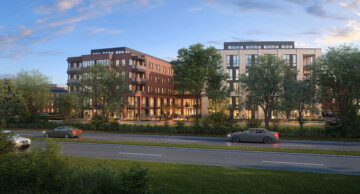
 Adaptive reuse brings back to life vacant, partially full and foreclosed office buildings in imaginative ways.
Transforming empty office buildings into much-needed housing gained greater traction during and after the pandemic.
But success depends on a host of factors and decisions. Developer Jeff Klotz, CEO of The Klotz Group of Companies, has found that pre-1980s buildings may be better suited due to smaller floor plates and more flexible layouts and concrete structures being generally easier to work with than steel-framed buildings with duct chases or non-load bearing walls. Architect Ben Kasdan, FAIA, LEED AP, NCARB, Principal at KTGY, finds two critical factors to determine viability are ceiling height and distance between a building’s face and its core.
The good news is that as remote and hybrid work continue and office buildings remain vacant or partly full, developers and other professionals have mastered a better understanding of how to deliver vibrant, financially successful apartment communities.
The experiences have led Lamar Johnson Collaborative to develop an adaptive reuse scorecard with inputs on factors such as building systems, building forms, amenities and sustainability. “We score items from 1 to 10, see how the total adds up and if the building is suitable for conversion, most often from a cost standpoint. Then, we dig into the details,” says Alan Barker, AIA, LEED AP, Principal and Residential Market Leader. “The advantage of older buildings is that they’re embedded in a city’s fabric,” he says.
One challenge that lies ahead is that many of the easier “low-hanging fruit” properties already have or are being worked on, says Taylor Vogt, with vertically integrated developer Model Group. “What’s left are properties that are difficult to convert due to deep floor plates or occupancy that prevents conversion without a large relocation effort and budget, but their vacancy rates aren’t sustainable for current owners to continue operating as-is,” she says.
Kasdan says, “Every project presents unique challenges and opportunities.”
Garden-style office buildings represent some of the easiest, best outcomes. These low-lying structures with narrow dimensions often make for faster, more affordable retrofits than larger, taller buildings, says Klotz. When such buildings have stick-frame construction, they often have crawl or attic space that permits easy access to electrical, sewer and water lines for rerouting. They may also have one common stairwell and no elevators, which reduces renovation work. Some may lack amenities, but in an Atlantic Beach, Fla., building, Klotz constructed a pool in a spacious backyard. The firm found room for a lease/reception area and converted a common kitchen into a café bar and business center. “A nearby beach represents a huge amenity,” he says.
Large buildings with deep, dark cores require imaginative solutions
Such cores aren’t suitable for living due to the absence of windows for light and air, but they present other opportunities, as CetraRuddy found in a 42-story office building of more than 1 million square feet in Lower Manhattan. The core will become a multi-level fitness center with double-height ceilings and exposed ceiling members, plus a spa, pickleball court, music/practice rooms, influencer spaces and game rooms, all on floors two to 11. In Worcester, Mass., The Architectural Team (TAT) redesigned an eight-story, historic former office building for 55 mostly affordable residences with the dark core transitioned on each level into intimate amenity spaces, says Scott Maenpaa, Project Manager. In downtown Cincinnati, Model Group added transom windows in inset bedrooms on three floors of a 1970s building that once housed Formica® Corp.’s headquarters and is part of The Mercantile Building, says Vogt. Chuck Bloszies, founder of The Office of Charles Bloszies, FAIA, envisions other possibilities, from shared offices to conference rooms, vegetable “gardens” in elevator shafts and parking for self-driving cars. Vogt says her firm has used them for an indoor turf run for dogs. “Coming up with ideas isn’t hard but plugging the right use into the right space is the bigger challenge,” she says.
Roofs offer valuable space
CetraRuddy has constructed pools on upper stories and rooftops on several office-to-residential conversions, including 55 Broad Street and SoMA/25 Water Street in New York City. Barker used the roof at a 1914 Daniel Burnham building at 208 LaSalle Street in Chicago for a patio. At its downtown Cincinnati historic project, Model Group removed defunct mechanical equipment atop the former Formica® building to create an indoor/outdoor sky lounge and patio facing the Ohio River and sporting venues. It installed new mechanicals on each floor for residential use. KTGY’s design for 1201 E. Abingdon Drive in Alexandria, Va., proposes expanding an existing mechanical penthouse and adjacent rooftop for indoor/outdoor amenities.
Layouts should anticipate the demographic
In New York’s financial district, where many young professionals are moving, CetraRuddy is re-designing floor plates mostly with studio and one-bedroom units—but some larger. “They come because they can walk to work, like living near parks and the water, and more services are opening,” says Eugene Flotteron, AIA, Director of Architecture and Principal Partner. One example is its 55 Broad Street conversion of a post-WWII curtain wall building. The firm added floor space but minimized the surface area of additions since adding more than 5% to any of the existing building elevations would require new bracing for the entire structure to meet the wind loading building code requirements. It also gained more space for apartments by switching out large mechanical equipment and placing amenities on one of the new floors. Model Group has tried to cast a wide net and appeal to a diverse community by designing smaller units in its historic Mercantile building, which has a smaller floor plate than the newer 1970s Formica® building, which gained larger units for its larger floor plate.
Empty buildings speed repurposing
Several cited finding it challenging to work on buildings where offices remain. “If their leases aren’t up and they won’t leave, we try to work around them or move them to another part of the building, temporarily or permanently,” Barker says. In the case of existing occupancy, plans must be well coordinated during design and construction to avoid disrupting businesses, he says. Vogt warns the process may take longer than expected, as it did at the Formica® building where office staff worked throughout the building. “It was a huge effort to get tenants out and happily relocated,” she says.
Mixed-use improves finances and appeal
Model Group has included different kinds of commercial spaces for each project. Vogt says, “Recently, banks have been hesitant to underwrite commercial space and view it as a risk. It is important to our team to create vibrant, 24/7 energy around our urban developments, so we find ways to make them work, but it certainly doesn’t make it easier to do the deal unless you have a committed anchor tenant.” In the case of one 18-story, pre-1980 building in northeast Florida, Klotz says the larger floor plates of the first five levels would have been more challenging to convert than the smaller upper levels. Therefore, he kept the lower levels for offices but updated them to an open-loft style, rented out the ground level for different services and added a lounge in a new residential entry. He converted the top 13 levels to 130 apartments. For a 22-story building that Lamar Johnson Collaborative adapted, the building includes hotel rooms on the top and bottom levels, and 226 apartments will occupy former offices in between.
Affordable rentals can be tough to pencil out without market-rate units or government subsidies. Model Group has found in Midwest markets, “it’s difficult to do even market-rate properties without some type of subsidy, such as tax abatements, historic tax credits or Ohio’s Transformational Mixed-Use Development tax credit (TMUD).” The Mercantile used all of these and more, Vogt says. Chicago’s planning department is making more TIFs (tax increment funding) available, says Barker. Alex Brito, AIA, Principal, Noma, with RKTB Architects, says that New York’s “City of Yes” (Zoning for Housing Opportunity) resolution, passed last year, encourages construction and conversions because of the need for affordable housing. Among its changes are permitting office- and warehouse-to-residential conversions in a wider geographic area. Others are courted, and preferably early in the process, says developer Miles Alexander III, Principal, Alexander Goshen, such as utility providers who may have a say in redevelopment approvals and neighborhood groups.
Financial contingencies help overcome challenges
Alexander and his firm know to build a 10% contractor contingency into a budget due to rising costs and structural work. He cites as an example a foreclosed former 1984 bank building on Atlanta’s West Side that was converted into 72 units of affordable housing with the Atlanta Housing Authority contributing funds. Before the process could get underway, issues arose about electrical and plumbing compliance and the need to demo walls, all of which added to costs. In Massachusetts, Maenpaa says, LIHTC state funding requires a 5% to 10% contingency to help minimize the cost of unforeseen conditions. “With good contractors, once new construction starts, they usually can make up contract time and deliver within a reasonable window,” he says.
The right team is critical
Having specialists on board often improves outcomes, and in the case of older buildings, historic consultants may be essential, says Maenpaa. “This member knows what can and can’t be done inside and outside,” he says. Also helpful are contractors who’ve worked on such projects. Klotz has found bank partners key when developers have defaulted, and financing is necessary to rescue a building. In a market like San Francisco where seismic upgrades are essential, having architects who understand this challenge is another asset, Bloszies says. Model Group brought in a third-party property manager to help with its downtown Cincinnati project, its first large one there.
Experience helps dictate what to leave or remove
Because the owner of one building undergoing a conversion wanted to get it to market fast, CetraRuddy left stairways and elevators but updated them. “It saved months and hundreds of thousands of dollars in carrying costs to start collecting rent on currently unrented space,” Flotteron says. With an 11-story, landmarked building at 166 Montague Street in Brooklyn Heights, N.Y., RKTB preserved as much as possible of the exterior’s ornate architectural details, including the granite base with limestone arches and Spanish tile roofing. The interior required a gut renovation. RKTB’s design inserted a new circulation core and repositioned floor plates to take better advantage of existing windows. Because tax credits were used in its downtown Cincinnati project, Model Group had to retain the appearance of radiators along exterior walls but topped them with a solid surface to fashion window seats.
Parking needs vary
Some locations may not require retrofits if the building has a garage or lot or if there’s nearby mass transit, but Vogt’s firm knew to add spaces in the basement of The Mercantile Building due to Cincinnati still primarily being a “car city.”
It also partnered with nearby garages to secure master-leased spaces.
Think optimistically
After working on many conversions, Flotteron thinks almost any building can be transformed. At its SoMA/25 Water Street project, the firm is converting the high-rise structure into 1,325 apartments and 20,000 square feet of outdoor amenity space. Work required cutting big parts of the building out to create two courtyards, adding space at the top with a 10-story overbuild addition to bring the building height to 32 stories and modifying the façade to increase windows. “It’s the most aggressive adaptive reuse we’ve done,” Flotteron says.