 Retail design has evolved beyond the conveyance of goods and into the realm of community amenity.
With more food and beverage, outdoor spaces and entertainment, retail centers are being viewed by many consumers and communities more as a place to spend time than purchase goods. While goods and services may still be at the forefront of their function, many developers have taken their cues from resorts and parks to understand how to give consumers an experience worth paying for.
“Retail developers increasingly recognize that consumers are seeking experiences that encourage longer visits and repeat trips,” says Neil Feaser, president of RKAA Architects. “Our response is to design projects that support multiple reasons to visit. The goal is to create destinations where shopping is one component of a broader experience that includes dining, recreation, social engagement and community interaction.”
Over the past decade, retail design has continued to evolve as dining, entertainment and public spaces become more prevalent features. Programming — in the form of arts events, farmer’s markets, concerts and live entertainment — has also become a big part of the community attraction factor at many centers. These components have become just as important as retail to the draw of a center for many developers and communities. With retail space at a premium, developers are focusing on providing the best environment possible.
“We’re seeing a significant shift toward retail environments that offer more than shopping alone,” says Derek Price, principal at MCG Architecture. “Owners and developers are increasingly incorporating entertainment, wellness, hospitality, dining and community-focused amenities to create destinations that drive repeat visits, extend customer service dwell time and enhance the overall value of their assets.”
CHANGING LANDSCAPE
The biggest shift in retail design over the past two decades has come from the influence of e-commerce. While retail once struggled with how to compete with e-commerce, it has now fully embraced online retail as another delivery channel. In convenience and service retail, this is demonstrated through the features like pick-up lanes and back-of-house fulfillment. In upscale environments, showrooming — using the store as a showplace — has become more common.
“E-commerce has shifted the role of brick-and-mortar retail from primarily transactional to experiential,” says Feaser. “Consumers can buy almost anything online, so successful retail environments must offer something that cannot be replicated on a screen.”
The influence from e-commerce is seen in many retrofits, redevelopments and new retail environments. Stores have to function as last-mile delivery points and deliver a seamless brand presence.
“We all know how easy it is to have something delivered to your doorstep, and we’ve all felt the disappointment when what arrives isn’t quite as advertised,” says Brandon Wernli, associate principal of KTGY’s retail studio. “This is where physical retail shines; to help establish a brand’s reputation and create a meaningful connection with customers. People do not make plans with family and friends to shop online, but we do come together to experience great retail destinations, and we crave authenticity in these experiences. The role of physical retail is to connect great brands with communities.”
Forging that connection with brands and lifestyle or community is where retail design plays an important role. This takes place within the store, but also in the overall collection that is the built retail environment.
“We work closely with developers, owners and retailers to design spaces that support today’s omnichannel strategies while remaining adaptable for tomorrow’s needs,” says Price. “That includes integrating efficient back-of-house operations and flexible tenant layouts that can evolve with changing merchandising strategies and future technologies. Today’s stores are no longer just places to complete a transaction; they’re integrated into customer experience and long-term asset performance.”
Because e-commerce’s influence might feel a little mechanical with its buy online, pick-up in-store mantra, many retailers have focused on the human side of retail. They have created stores that appeal to consumers’ passions and lifestyles. The shopping environment, as an extension, has done the same, taking cues from hospitality and even home interior design.
“What once felt elevated or unexpected is quickly becoming the baseline expectation in many environments, and retailers are responding by designing spaces that feel more intentional,” says Spencer Farley, director of the entertainment, hospitality and retail practice at Dimensional Innovations.
“The human experience matters,” adds Noel Cupkovic, principal architect with Cupkovic Architecture. “While e-commerce is convenient, the experience of shopping remains necessary for the human experience.”
RDC has worked with Erewhon, the Los Angeles-based specialty grocer, to create environments that appeal to an audience that values health and wellness. The stores create a connection that goes beyond transaction.
“The ethos of Erewhon is indicative of the movement toward food as entertainment,” says Sean Slater, senior principal of RDC. “Its success is a direct response to e-commerce and a reaction against underwhelming experiences with grocery delivery through the pandemic and continuing to the present.”
Retail environments like Skyline Pitch at Caruso’s Americana at Brand have added uses that expand the definition of retail. Skyline Pitch is a soccer venue that allows teams to practice and play with the backdrop of the Los Angeles skyline. It is located on the top level of one of Americana at Brand’s parking garages, monetizing underutilized space while providing a needed amenity for the area.
“By creating soccer and other physical fitness experiences ‘in the sky,’ Caruso and the RDC team have created a layered experience in a three-dimensional space while preserving the essential ground plane for shopping and civic entertainment,” says Slater, whose team at RDC designed the facility.
Wellness and a focus on entertainment and food and beverage tenants are two other drivers that are changing retail design. They are not only reasons for consumers to visit a center, but can be a catalyst for them to stay at a property longer. Think of the restaurant dinner that turns into a shopping stroll.
“F&B has become a dominant connector and is often the anchor of physical retail,” says Wernli. “Local restaurants are becoming hot spots that give consumers a reason to visit, stay longer and come back. Whether it’s a coffee shop or a full-service restaurant, F&B can create this gravitational pull for healthy retail.”
Retailers have caught on to this trend, as have restaurants. They are using elements of each to connect their brands with consumers.
“There’s a blurring of the line between F&B and retail,” adds Wernli. “Coffee shops have merchandise that you can impulse buy at the counter. Local boutiques will have a little espresso bar in the back. Brands are starting to do collaborations by putting retail kiosks inside grab-and-go restaurants.”
Many centers have also shifted their tenant focus to include these categories.
“Five years ago, we were occasionally designing custom restaurants for our clients,” says Cupkovic. “Now, we’re working on a new mixed-use center in Florida that will have an entertainment anchor and the F&B works like a co-tenant for the entertainment. Projects are different — F&B is always important for the human experience.”
DEMOGRAPHIC SHIFT
While the retail industry is seeing a shift in demographics — Millennials and Gen Z are the primary shoppers, while Generation X and Baby Boomers ease out of their gathering years — retail design must appeal to everyone. In most cases, the wants and needs of all generations are the same. Influenced by popular culture and trends, many consumers seek goods that are aspirational and durable.
“There is a strong connection between what older, active adults want and what young families want,” says Wernli. “Both want quality over quantity. They don’t want to be tied down to a car, and they want to get out of the house and spend their time in a space where they can meet people, access a variety of services and come away feeling better for it. The specifics of what they buy may vary, but the synergy between these two generations is that they want third spaces that are easy to access and give them a sense of ownership.”
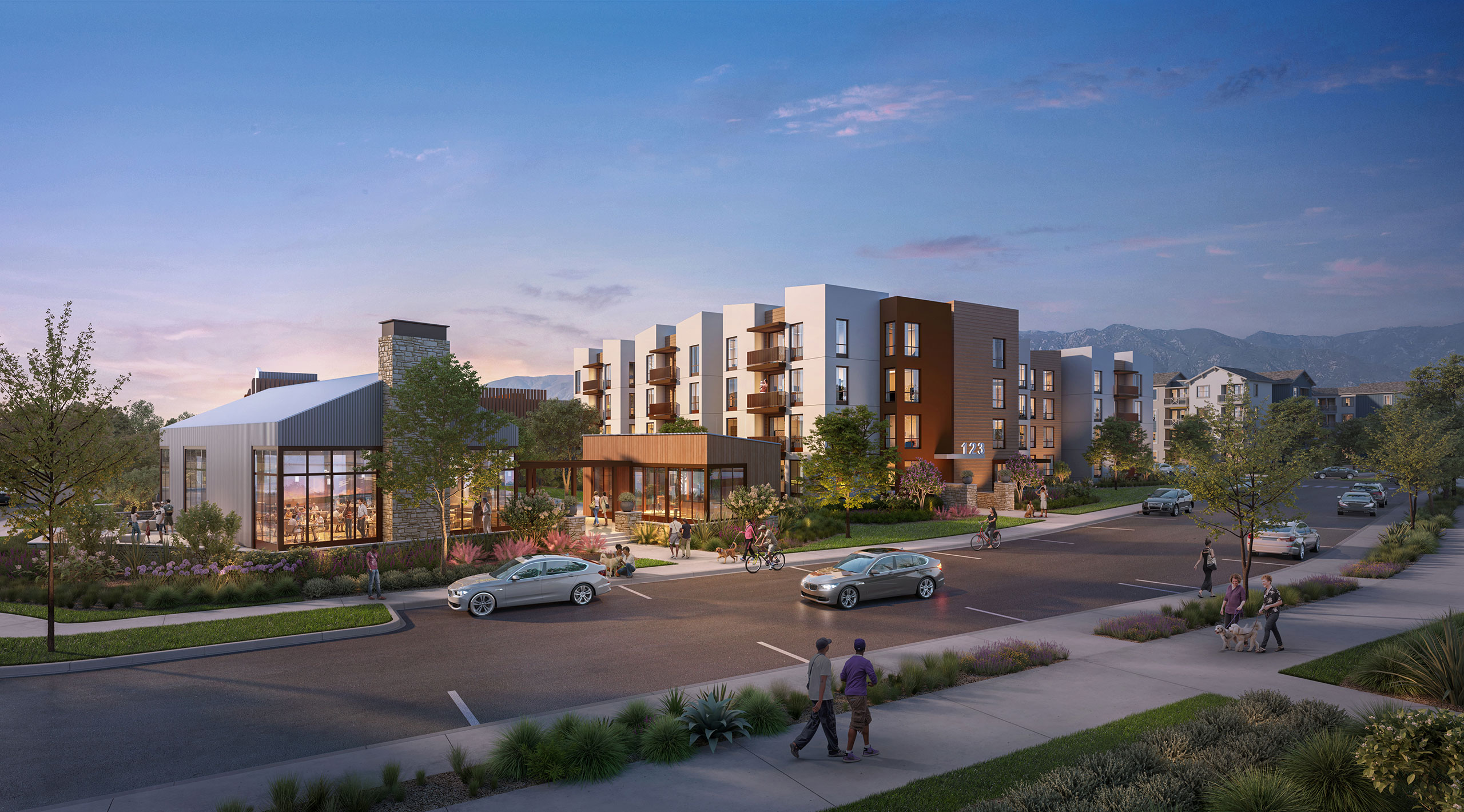
KTGY is designing a project called The Orchard in Santa Barbara, California, which features a commercial center that is built cohesively with residential components. A small footprint grocery store and two-story restaurant space are pillars of the project.
For the past 15 years, retail center owners have focused more on the experience at an environment. That can mean anything from how easy it is to access a center’s stores to the feeling a shopper gets when they walk through a center. It’s applicable to all center types.
“Younger consumers often value experiences, authenticity, social interaction and digital connectivity, while older consumers frequently prioritize accessibility, convenience, comfort and ease of navigation,” says Feaser. “Good design serves both groups by emphasizing intuitive circulation, comfortable gathering spaces, accessibility, technology integration and a diverse tenant mix that appeals to different lifestyles and interests.”
Center design not only has to take into account what is popular with consumers today, but what they will want in the future. Tenants realize their spaces must stay fresh to keep reinventing their experiences. That has led to them changing fixtures and décor more often than in the past to stay relevant. Owners have realized that what is built today must eventually appeal to a generation that is just being born. As a result, architects are called on to create dynamic spaces that are flexible for many tenant types, including those not even thought of yet.
“We design for the next 20 years, not opening day,” says Frankie Campione, principal of CREATE Architecture. “Retail has always served multiple generations. The challenge isn’t designing differently for Gen Z than for Baby Boomers; it’s creating places that are intuitive, comfortable, authentic and memorable for everyone. Great retail isn’t age specific, it’s human.”
“We believe successful retail environments aren’t designed for one demographic,” adds Price. “While shopping habits vary across generations, the best retail destinations share common qualities that are welcoming, accessible, convenient and memorable.”
One push that designers see as important — and maybe correlated to e-commerce’s influence and a younger generation more present at centers — has been the incorporation of more technology into the retail environment. From digital advertising to LED lighting in storefronts and displays, retailers and retail landlords are getting creative by using technology to attract consumers and create convenience.
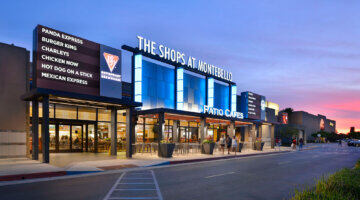
In Montebello, California, KTGY repositioned an older regional mall, opening up a closed-off façade to create a transparent and accessible frontage for the project. Digital signage, clear storefront windows and patio seating became incorporated into the front of the center.
“Anchor tenants loved the increased opportunity for branding, especially with the digital signage, and the shops and food court benefited from a view to the outside,” says Wernli.
Between a generational shift and technology, retail is changing, which is leading to changes in how retail spaces are designed.
“Retail will continue to become less transactional and more experiential,” says Campione. “The center that thrives won’t simply add amenities; it will create a memorable environment that people will visit even when they don’t have to. The most enduring retail environments are rooted in authenticity, not trends. When architecture responds to its climate, culture, history and people, it becomes timeless because it is genuine, not because it follows the latest aesthetic.”
MAKING PLACES PERSONAL
Placemaking has long been a focus of design for public-facing spaces. For retail-centered projects, creating a sense of place is paramount to increasing the amount of time consumers spend. Developers, retailers and designers have increasingly focused on making projects feel more personal to consumers. Neighborhood centers must fit the lifestyle of the surrounding community; regional mixed-use projects must appeal to the broader community to become third places where residents like — and choose — to spend their time.
“Placemaking starts with understanding the community, the market and the owner’s vision,” says Price. “Every project has a unique context and successful retail environments reflect the people they serve rather than relying on a standardized approach. We look beyond the buildings themselves to create destinations that encourage people to gather, interact and return.”
“We look for opportunities to reflect local identity through architecture, materials, landscaping, public spaces, art and programming,” says Feaser. “The goal is not to create a generic retail product but a destination that feels connected to its surroundings. Projects that embrace their local context tend to create stronger community support and long-term customer loyalty.”
That connection with the customer is making placemaking more personal. Consumers who find relevance in spaces — a connection — want to spend more time there.
“Rather than creating places that could be ‘anywhere,’ we look for opportunities to design for specific individuals and families who may visit the site,” says Slater. “We ask ourselves a series of questions related to physical space to elicit new and unexpected solutions.”
Slater cites the work that RDC has done on the new TMC at the Medical Center in Houston, a district that will bring retail, restaurants and medical office to one of the largest medical campuses in the world.
“We recognized an underrepresented customer in the tens of thousands of nurses, doctors, administrators and visitors to the area’s medical facilities,” he says. “All decisions related to the physical design are run through a process of ‘what would Jane do?’ ‘How can we get Jim to linger here on his lunch break?’ and ‘what amenities, services and rituals can we build into the site to create repeat visits, especially on weekends and in the evening?'”
Placemaking used to be relegated to mixed-use projects and high-end malls. Today, it extends to every project. CREATE recently worked on the new Tanger Outlets Sevierville in Tennessee, which recently underwent a year-long renovation.
“Our challenge wasn’t to reinvent the property but to restore its sense of place in the Smoky Mountains,” says Campione. “Rather than relying on a cosmetic facelift, we broke down the scale of the buildings into a series of smaller, more pedestrian-friendly experiences. Varied rooflines, layered materials, outdoor gathering areas, enhanced lighting and a richer architectural rhythm transformed what has become a continuous retail edge into a walkable environment that invites people to slow down, explore and stay longer.”
Likewise, how buildings and amenity spaces are positioned can have an effect on how consumers interact and receive a space.
At a retail project in Florida, Cupkovic Architecture created a “technology park” for daytime users and an open-air pedestrian main street with hardscape and landscaped event spaces. The center plans events that relate to the communities to create an additional traffic draw.
“Creating active gathering spaces and organizing the buildings around these spaces makes the center feel like a town square,” says Cupkovic. “The space between the buildings and how it is organized creates an inherent feeling of community.”
At the Lee’s Summit Green Street redevelopment project in Lee’s Summit, Missouri, Dimensional Innovations incorporated public art and interactive lighting to create a gathering place that draws residents during larger community events.
“Over the next decade, I think the push toward hyper-personalization will only continue to grow,” says Farley. “Customers increasingly expect retail environments to reflect their preferences, personalities and choices — and that will continue to drive advancements in technology. For us, that reinforces the importance of designing adaptable retail environments. Customer expectations change, products shift with seasonality and floor plans need to remain flexible.”